



Financial literacy is an essential but primarily undermined skill that can make or mar a country’s future. As much as the government has economic analysts and financial advisers to predict the country's economic direction on a macro-level, micro-level financial literacy in India is still suffering.
Standard & Poor’s survey showed that 76% of the Indian adult population is financially illiterate. This figure was determined in a global study where the company assessed citizens’ knowledge of four fundamental concepts of financial decision-making. India had a 24% financial literacy score, while countries like the United States and Canada had 57% and 68%. Considering that India makes up 17.7% of the world’s population, this number is disappointing.
During the survey, it was deduced that national-level policies related to education and consumer policies helped shape financial literacy in countries with more prosperous economies. Therefore, a micro-level understanding of financial literacy is necessary to boost the nation’s economic growth.
The Indian Government, through varying agencies, set up the National Centre for Financial Education. The centre aims to promote financial education across India. However, this campaign does not include financial literacy programs in the school curriculum.
Here are reasons why such a move will be beneficial to the nation.
Advantages of Teaching Financial Literacy in Schools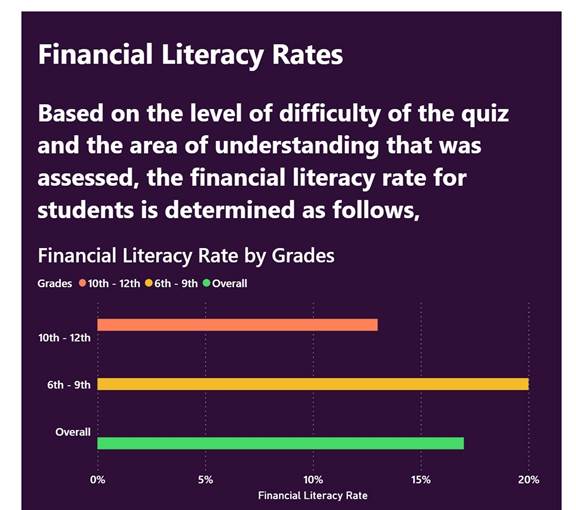
According to a survey carried out in 2021 by Streak, a teenage Edu-fintech platform, the overall financial literacy rate amongst children in the 6th to 12th grades is 17%. Incorporating financial literacy into the school curriculum will lead to a rise in these numbers.
Here are the advantages of such a nationwide move:
1. Increases the chances of making the right financial decisions
Understanding financial literacy is like mathematics. You start with the numbers, then learn addition and subtraction before getting to division and multiplication. In personal finance, you must first grasp simple concepts like savings before getting to more complex ones like taxation and budgeting.
Therefore, as with any formally taught subject, the earlier a person starts learning it, the higher their ability to understand it as the years go by. During childhood, the brain develops quickly, and children can soak up what they're taught much more quickly than adults. Hence, if children are able to understand the concepts of financial literacy at a young age, they are more likely to make the right financial decisions in their adult years.
2. It will prepare them for an unpredictable future.
Twenty years ago, no one knew that digital banking and transfers would be possible. But now, mobile apps and international money transactions are rife. Many people were still trying to get a grasp of that, and boom. Cryptocurrencies.
It’s like every five years, something big comes to shake up the financial world and make people rich almost overnight. And you know the people that do not benefit from disruptive times like this?
Yes. The ones with little knowledge of finances. By including this skill in the syllabus, we will give the future generation the basic skills necessary to understand things like futures, credit cards, mutual funds, etc. Familiarity with these concepts will give them an edge in these constantly-developing times.
They may not be 100% aware of new financial trends, but they will be somewhat knowledgeable. Their foundational understanding of finances will make it easier for them to tread on these unknown grounds.
3. To turn theoretical knowledge into practical situations.
The US survey by FINRA (The Financial Industry Regulatory Authority) found that young adults who participated in state-mandated financial education programs in high school were less likely to borrow high-interest loans. Financial literacy is a skill that blooms in practical situations.
India’s general literacy rate is 77%. However, there are only 13.8 million white-collar workers in India, while blue-collar jobs are as many as 500 million. This means that students may never get to use specific subjects taught in school because the blue-collar job market might not require them.
However, any knowledge students gain in personal finance would be beneficial to them, no matter the industry they eventually find themselves in. The universal need for this skill makes it imperative to teach it in schools.
4. To give everyone a chance at an improved quality of life:
Studies have shown that children from poor households in India are less likely to complete their education. This can be due to numerous factors, such as little funding, pressure to work, and lack of interest.
Thankfully, the Right to Education Act made education accessible for children between 6 and 14 years. This has allowed many children from less-privileged households to access basic education.
If these financial literacy programs are added to school curriculums, children from every household will also have access to it. Whether or not they go on to attend secondary or tertiary institutions, the school would have still introduced them to the basic tenets of financial literacy.
 Conclusion
Financial literacy is a life skill that everyone should have access to as early as possible. Integrating it into the school curriculum will be the most seamless way to ensure widespread access. That way, we can be sure that the next generation of Indians will make better financial decisions and be more confident in their finances.