



There has been a large-scale interest in B2B content marketing in recent times. This is because content development as a marketing strategy has proven to be one of the most effective marketing methods for B2B companies.
Interestingly, the content marketing industry was predicted to hit a $50 billion benchmark in 2019. However, it moved beyond that benchmark to about $66 billion in 2021 and is projected to hit $137.2 billion in 2026. The increased interest in this industry reflects its importance in the marketing process. It has come to a point where businesses ignore content marketing at their peril. According to Statista, 46% of B2B companies plan to increase their content marketing budget in 2022.
But before your business jumps on this trend, it would be reasonable to get a basic understanding of what B2B content marketing is and why it is so vital for B2B companies. Let’s dive in.
What is B2B Content Marketing?
First of all, B2B stands for ‘business-to-business.’ B2B companies sell products or services to other companies. B2B content marketing strategy is a form of marketing strategy used by B2B companies where content is used to attract their target audience, build brand loyalty, convert leads, and ultimately drive sales.
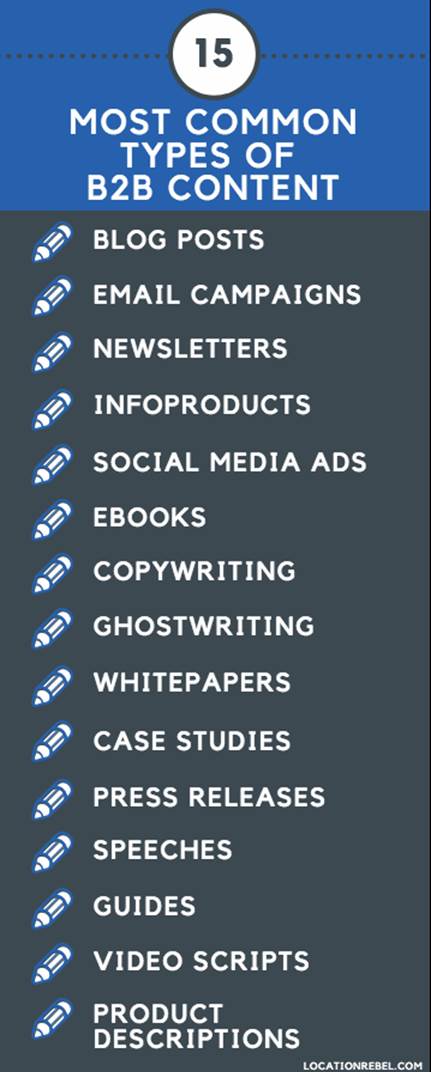
B2B content can come in several formats, but the top five are email, blog posts, social media, webinars, and events (virtual and real-life). There are many examples of B2B content formats.
The most common ones are listed below:
B2B vs B2C Content Marketing
You should know that B2B content marketing is fundamentally different from B2C (business-to-consumer) content marketing. There are three significant areas where the two diverge.
1. Content Style
B2C content is typically interested in audience demographics and psychographics, leveraging heavily on consumers' emotions to drive sales. It takes note of trends and uses storytelling heavily.
B2B, on the other hand, takes a more logical approach to content. It focuses on not just audience demographics but also user intent. Finally, it is concerned with complex products and services.
Some businesses believe that B2B content should always be rigid and logical. I think B2B content writers and marketers should remember that, as much as they are selling to companies and dealing with complex processes, those companies are still made up of humans.
Humans are naturally drawn to stories and would trust a relatable brand more, whether B2B or B2C. For example, Salesforce uses marketing testimonials heavily on their website to tell the stories of their clients, and these ‘Success Stories,’ as they are called, are a marketing move that would appeal to company execs globally.
My point is that a bit of humanity in one of their content formats won't hurt anyone.
2. Distribution Channels
B2C content gets nearly 10x more shares on social media than B2B content. Hence, B2C content marketers are more likely to focus their efforts on social media platforms. Most B2B companies distribute their content via email newsletters, webinars, conferences, search results, and websites.
3. Target Audience
This area can get tricky. In B2C content marketing, the target audience is more extensive than in B2B. However, the buying group is smaller.
This means that B2C companies have to create content for a large target audience, e.g. a million men in the world who want to buy size 10 Chelsea boots. But at the end of the day, only one person will have to decide if they will get that shoe or not.
But with B2B content, the opposite is the case. The audience is smaller, e.g., companies of 10 to 1000 that require SaaS solutions. However, the content doesn't have to convince just one person. The buying group is larger because key business executives have to discuss and agree on the purchase before any sales can happen.
So, the B2B content has to be compelling enough to persuade both the CEO and the head of IT that they need the help of that company that offers SaaS solutions. Most B2B content is brimming with logic, facts, and figures for this reason.
Why is Content Marketing Important for B2B companies?
There are tons of reasons why content marketing has been recognised as an essential marketing strategy for B2B companies. Here are a number of them, backed with statistical data.
1. It builds trust and generates leads:
More than half of the B2B buyers say they are more likely to buy from a business after reading its content. Also, companies that blog consistently generate 67% more leads monthly than companies that don’t.
2. It is a cheaper and more effective marketing strategy:
Content marketing generates three times more leads than traditional marketing methods, although it costs 67% less.
3. Companies that focus on their content marketing are more likely to be successful:
Marketing teams in B2B companies with the highest success rates spend about 40% of their marketing budget on content marketing.
4. It helps with visibility:
Small businesses with blogs get 126% more leads than small businesses that don’t.
In Summary…
B2B content marketing has proven to be a necessity for B2B business growth, and that is not ending anytime soon. Investing in an efficient content marketing team is not just a choice anymore if you want your business to remain relevant.
You can build an in-house team or outsource your content marketing needs. All that matters is that your business pays attention to this essential strategy and utilises it to boost your growth and achieve company goals.